Will the real Brandon Lang please stand up?

This one is a real headscratcher.  I have to make an initial disclaimer before diving in – my firm is currently representing a defendant in an unrelated case brought by the same plaintiff in this case.  This post reflects my personal opinions and is not related to any issues in the case I’m working on with the firm.

With that said, Florida IP Trends presents:

Stevo Design, Inc. v. Brandon Link,  Case No. 1:2010cv24283 (SDFL December 1, 2010)

Complaint| Exhibit A |Exhibit B

Two for the Money

According to the complaint, “Stevo Design provides sports handicapping services. In general, handicapping is the practice of assigning advantage through scoring compensation or other advantage given to different contestants to equalize the chances of winning…Stevo Design operates over 7 internet-only sports handicapping brands, and services over 10,000 unique clients worldwide. This is accomplished online via pay-per-view sports analysis and selections, or what is commonly known as providing ‘Sports Picks’. Stevo Design employs more than 15 full-time sports handicapping professionals to analyze games and sporting events on a daily basis throughout the year and deliver their opinions and rated selections to clients.”

Several years ago, a movie was made about the world of sports handicappers. The film was called Two for the Money, and it starred Al Pacino, Matthew McConaughey, and Rene Russo.  One of the main characters was based on a Stevo handicapper named Brandon Link.  As far as I know, Brandon Link is Brandon’s real name.  However, in the movie, Mr. Link is named “Brandon Lang.”

Sensing marketing opportunities, Stevo submitted a service mark application to the U.S. Patent and Trademark Office (“USPTO”) for the mark “BRANDON LANG” for the following services: “Handicapping for sporting and other entertainment events.” The application was submitted March 15, 2007, and a registration ws issued on June 17, 2008.  The registration information may be viewed HERE.

It’s somewhat rare, but not unusual, for a living person’s full name to receive a trademark registration, but given the obvious boost in visibility that the movie would bring to Stevo’s services, it makes sense that Stevo would want to protect the Brandon Lang “brand.”  Following the success of the movie, Brandon Link continued offering his handicapping services under the Brandon Lang name.

As alleged in the complaint, at some point the relationship between Brandon and Stevo broke down.  The details are in the complaint, but ultimately, the parties decided to part ways.  They signed a separation agreement, and one of the counts in the complaint is based on Brandon’s alleged breach of that agreement.

The reason that the case is appearing on Florida IP Trends is because of the unique trademark infringement issue – specifically, infringement of the registered BRANDON LANG mark.  The infringement is allegedly based on Brandon’s use of the BRANDON LANG name in providing handicapping services and in the use of Brandon’s website, which is located at www.therealbrandonlang.com.  Stevo runs www.brandonlang.com.  [12/7/2010 UPDATE:  I noticed that one of the search terms used to hit Florida IP Trends was “brandon lang, website cancelled” so I checked out both sites.  It does appear that therealbrandonlang.com is currently down.  Perhaps settlement talks are underway.]

Brandon Link/Lang

Sharp readers are probably scratching their heads at this point.  That’s right, The case is Stevo Design v. Brandon Link.  Brandon Lang is a fictional character in a movie.  (I couldn’t find any fictional name/dba’s in the Florida Secretary of State records.)

So, doesn’t Stevo still have the right to prevent others from offering services under a trademark registration owned by Stevo?  Absolutely.  But here’s the problem.  In order to obtain a trademark registration for a personal name, the applicant must inform the USPTO if the mark does indeed identify a particular living individual, and if so, then that living individual must submit a signed consent statement indicating that he or she consents to their name being used in the trademark application.

As THIS document shows, on June 23, 2007, the USPTO Examining Attorney followed proper procedure by asking Stevo if Brandon Lang was a living individual, and if so, then a consent form was required.  If Brandon Lang was NOT a living individual, then Stevo was supposed to reply as such.

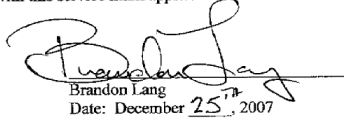
Responding three days past the six month deadline for a response, on December 26, 2007, Attorney Mark Jordan submitted a signed consent form from “Brandon Lang.”  You can view the form HERE (see page 3).

Say huh?  Sure as heck, on Christmas Day, 2007, one “Brandon Lang” signed his name to a form indicating that he consented to his name being used in the trademark application.

I’m no Columbo, but I had a hunch.  Luckily, one of the exhibits to the Stevo v. Link complaint is the separation agreement signed by Brandon Link.  Let’s compare Mr. Link’s and Mr. Lang’s signatures:
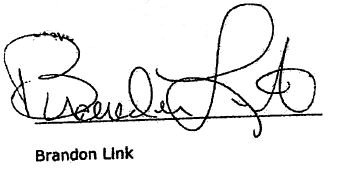
Rut-ro.  I’m also no handwriting expert, buuuuuuut…..

So here’s the problem.  If there is no living individual named Brandon Lang, and Stevo (or the attorney handling the application) knowingly submitted a document that [cringing] falsely [/uncringing] represented that Mr. Lang does exist, then the entire trademark registration is at risk.  That means canceling the registration – or perhaps the registration would be void.  That means no trademark infringement as to the registration.

Stage names are registrable with the USPTO, but the “real” person should – or at least typically does – sign their real name on the consent form.  For example, Mario Lavandeira signed the consent form in the trademark application for his stage name, “Perez Hilton.”

This is a fascinating issue – a real person signs the name of a fictional character loosely based on his own persona in an attempt to register the fictional character’s full name as a trademark.

Ultimately, if the trademark registration is canceled, I think hindsight will show that a simple response to the Examining Attorney’s June 23, 2007 office action indicating that “Brandon Lang is a fictional character” and/or having Brandon Link sign his real name for the “Brandon Lang” pseudonym would have prevented this entire mess.

Wonder what the odds are?

Grabbing my popcorn…

Supreme Court sends USC to the locker room

Big thanks to my mom for alerting me to this new development:

We will not have a USC v. USC at the U.S. Supreme Court.  As previously blogged here, the University of South Carolina and the University of Southern California duked it out on a trademark issue recently, with the REAL USC (South Carolina) taking a shiner.

As reported by the Associated Press, the Supreme Court has declined to hear the case, thus leaving in place the Federal Circuit’s decision that prevents USC (the real one) from obtaining a federal trademark registration for its own “SC” logo.  See WIS-TV story here.

Note – the story states that “Courts have rejected South Carolina’s trademark.”   NO, NO, NO, NO, and NO!!!  The United States Patent and Trademark Office rejected South Carolina’s trademark application.  South Carolina can still use the logo as their trademark – they simply cannot get the benefit of federal registration.  And while we’re on the “what makes an anal IP attorney cringe” kick, don’t use “trademark” as a verb.  Ever.  You do not “trademark” something.  People typically mean “apply for a trademark registration” when they use trademark as a verb.

Outlaws – Case Update

I first wrote about this case in January, shortly after the complaint was filed. Just checked PACER for any updates, and, Wow!  This one is getting expensive quickly!

As I noticed, the attorney who filed the case wasn’t admitted to the Florida Bar, and the defendants’ attorneys pointed that out in the first motion to dismiss.  Yes, I said their first motion to dismiss. Three months in, and we already have two motions to dismiss with two orders!  (Local counsel has now appeared, and the original attorney has been admitted temporarily for this case.)

While I called the complaint a “doozy” in my original post, the judge gave it the kiss of death by calling it a shotgun pleading (fitting for an outlaw?).  This is a style of drafting a complaint where each claim incorporates all of the factual allegations preceding the claim.  Many complaints are drafted this way despite the fact that they are improper.  For example, if the second and third claims in a complaint both re-allege all of the preceding factual allegations, then the defendant technically doesn’t know which allegations belong to a specific claim – and that violates the federal rules of procedure.

The defendants’ attorneys picked up on this (and other issues in the original complaint) and filed a short and sweet motion to dismiss.  The judge agreed (on the same day!) and gave the plaintiff permission to file an amended complaint.

Guess what happened?  The plaintiff must have had a double-barreled shotgun because they did it again!  Not only that, but they also added on this nugget – which makes a First Amendment attorney such as myself cringe.  In the prayer for relief, the plaintiff has asked that the court to:

Order all Defendants to abstain from in any way discussing, commenting upon, or mentioning Plaintiffs in this action in public, in performances, or in any other public venue;

What!?  So, plaintiff wants, say, Henry Paul, to be legally prohibited from mentioning not only the case, but the mere existence of Outlawlessness Productions in public?

Plaintiff, meet the Streisand Effect.

Defendants’ First Motion to Dismiss (3/23/2010)

Order on First Motion to Dismiss (3/23/2010)

Amended Complaint (4/7/2010)

Defendants’ Second Motion to Dismiss (4/22/2010)

Order on Second Motion to Dismiss (4/23/2010)

Lake Mary High, Sponsored by Chrysler

Well, who couldn’t have seen this coming.  The earlier story regarding how Lake Mary High School basically ripped off the Chrysler ram logo has been updated.  The new info is this:  Lake Mary High will not have to immediately change all of the logos.  Instead, Lake Mary High will become a “Proud Partner of Chrysler.”  No word yet on whether Shell or Sunoco will be the official fuel.

Even Douches Deserve Trademark Protection

This post is painful to write.  It involves tattoos.  I like tattoos.  I even wrote my final law school paper on the intellectual property issues surrounding tattoos.  It’s not painful to write this because of the pain of being tattooed, rather, it’s painful to write because it involves such a touchy subject in the tattoo world:  Don Ed Hardy.  He is a legend, and his Japanese-style tattoos are instantly recognizable.  So why is this incredible artist a touchy subject in the tattoo world?

This:

Image from hardlycool.com

And this:

Jon Gosselin

And this:

Fashionistas?

You see, Ed Hardy clothing has become the “uniform of the douche.”  Fair or not, that’s what has happened.  I won’t get into the psychology of it all, but you can find plenty of analysis online.  A simple Google search for “ed hardy douche” will point you in the right direction.  Here, I’ve done it for you.

I’m sure Mr. Hardy had no idea that a simple licensing agreement designed to bring in some extra cash would turn into this, but if you want some $140 jeans with “Ed Hardy” on the ass, proceed to the checkout.  Thank you, Christian Audigier (who may be the ultimate douche in all of this).

Given my respect for Hardy and my keen awareness of what has happened to the brand, I wasn’t really surprised when I saw this new complaint filed in the United States District Court for the Middle District of Florida.

  • The case is Hardy Way, LLC v. A.J. Nails, Inc. and Johnny P. Tran.  Complaint HERE.

I have to admit that when I saw “A.J. Nails” as a defendant, I figured the case might involve some awesome airbrushed fingernail allegations.  I was wrong.  This is actually a fairly typical complaint concerning counterfeit goods – specifically, bogus Ed Hardy clothing.

Trying Too Hard

The complaint spends half of its 12 pages praising Hardy’s talent, and Hardy Way’s marketing skill.  It’s actually a very nice wiki-esque explanation of how the licensing deal came about.  We are even treated to a list of goods that bear the Ed Hardy trademarks, including, but not limited to, shoes, hats, jewelry, beverages, home goods, skateboards, snowboards, mobile digital content, fragrances, tanning products (ed: biting tongue), toys, and, drumroll please…. limited edition Smart Cars, which, tellingly, come autographed by Christian Audigier, not Ed Hardy.

I predict that Don Ed Hardy clothing will be in the clearance bins soon – these ultra-trendy brands all share the same fate.  Von Dutch, FUBU, Ed Hardy – the rich and famous wear them for awhile and then the (orchestrated) coolness wanes while the next $140 pair of jeans is being stitched up overseas.

Anyway, until that time, enjoy Don Ed Hardy’s enforcement of its brand via this new lawsuit.

(Note:  no matter how “douchetastic” a brand may have become, the owner of the mark still has a duty to police its mark and prevent infringement and dilution of that mark.  In that regard, if the allegations in this complaint are true, then Hardy Way deserves the remedies it seeks.)

Grab Your Logo By the Horns

Shame, shame, shame.  This tale of trademark infringement comes from just a few miles away from my office.  Lake Mary High School is the home of the Rams, and apparently the person in charge of branding thought the Dodge Ram logo was just perfect for the school.

The Orlando Sentinel posted this comparison of the logos:

Logo comparison via the Orlando Sentinel

Oops.  More coverage HERE.

Goofy Little Chicken?

I know this blog is Florida IP Trends, but when my alma mater gets kicked around, I’ll bend the rules a bit.

The University of South Carolina.  My grandfather ran track as a student and went on to coach the swimming team for years.  My mom went there.  I met my wife there, and we were even married at the Alumni House on campus.  My blood is garnet and black (Pantone’s® PMS 202 for the garnet – if you’re picky…)

Classy garnet & black USC hat with McDonald's-themed Southern Cal hat

The Court of Appeals for the Federal Circuit has just affirmed a Trademark Trial and Appeal Board decision in favor of the University of Southern California based on a trademark opposition proceeding they initiated against USC.  (PDF of the decision HERE.)  The original TTAB decision was in 2008, and this new decision is merely the result of South Carolina’s appeal of that decision.  MP3 of the oral argument available HERE.  Basically, USC wanted to register the interlocking stylized SC logo as shown in the top hat in the picture to the left.  Southern California has a trademark registration for SC in “standard character form” for similar goods.  This essentially allows them to prevent any other company or university from using “SC” in any font for goods that are similar to those in Southern California’s registration.

In the wake of the appellate decision, the sports blogs and media outlets have been running with the story.  See HERE, HERE, HERE, HERE.  (John Welch of the excellent TTABlog® also commented HERE.)

Sadly, one of the most talked-about things in this whole case is the University of Southern California’s attorney’s attempt to be funny in remarking on the ruling.  The Los Angeles Times is reporting that attorney Scott Edelman suggested that the interlocking SC logo was a better fit for the Trojan’s warrior image as opposed to USC’s “goofy little chicken” and that it was “totally understandable” that USC would want to move way from the Gamecock logo (which USC isn’t doing BTW).  Say what?   If we must use “chicken” at all, we prefer the phrase “ass-kickin’ chicken” to “goofy little chicken,”  but the comment was just rude and unnecessary.  I’m sure all the Tommy Trojans out there will be high-fiving Edelman for his disrespect.

On one hand I think it’s great that people are talking about trademarks and the opposition process, but on the other hand, it’s painful to see the misinformation about that process.  I have seen several articles that suggest USC will not be able to use any “SC” logos anymore.  This is not true.

I’m directing you to a post that my law school Trademarks professor happened to write just the other day concerning the difference between opposing a trademark application and suing someone for trademark infringement.  There is a big difference, and the fact that USC might not be able to register the interlocking SC logo does not necessarily mean that they can’t still use it.  To prevent USC from using it, Southern Cal. would have to initiate and win an infringement lawsuit – a lawsuit which would be decided based on whether or not the consuming public is likely to be confused by the logos.  So, onward to Professor Randazza’s post.

NOTE: According to the oral argument, USC and S.Cal. have an agreement providing for both schools to have USC registrations.  A registration is very valuable when negotiating licenses because it shows the potential licensee that the trademark has been vetted by the USPTO – which, in theory, means the chance of a lawsuit over the trademark is diminished.

Ironically, if you would like more information about the University of South Carolina, please visit www.SC.edu.

Lawlessness Among the Outlaws

Many people think of Florida as a tropical paradise with palm trees, convertibles, and theme parks lining every street.  While that may be true for some parts, Florida also has a rich deep-fried-and-countrified history filled with the cliches most people associate with Georgia, Alabama, and South Carolina.  (TruckNutz?  You can thank Florida.)

Lynyrd Skynyrd, Molly Hatchet and 38 Special?  Jacksonville, Florida.  Tom Petty and the Heartbreakers? Gainesville, Florida.  Outlaws?  Tampa, Florida.  (Source)  (It’s the last band, Outlaws, that brings us to the current lawsuit)

Band lawsuits are nothing new.  They are typically filled with allegations of broken contracts, trademark and copyright infringement, and perhaps most importantly, hurt feelings.  Band agreements are the prenup agreements for polygamous relationships that must survive the hardships of touring, recording, and basic human maturation and evolution.  No band is immune.  Some take it out on each other physically (hello, Gallagher Brothers), and some spend their hard-earned royalties to hire attorneys.  The Beach Boys, Violent FemmesDead Kennedys (I know, not very Dead Kennedy-y of them), Wilco – all have had some dispute over the band’s intellectual property.

Notwithstanding the obvious irony, the corporate machine behind the Outlaws is now seeking some legal intervention over disputes with former members.

The lawsuit was filed in the United States District Court for the Middle District of Florida, Tampa Division, on January 6, 2010.

The first thing to note is that the complaint was signed and filed by an Illinois attorney who is apparently not admitted to the Florida Bar.  Also, there is no local counsel designated, so I would expect an application for a special appearance to be filed soon, or else the complaint might be kicked out.

Also, and this is even worse – if you’re a badass Southern Rock band, make sure your attorney spells “Lynyrd Skynyrd” correctly.  It’s spelled “Lynard Skynard” in the complaint, and that’s pretty much sacrilege around these parts.

Notwithstanding the Skynyrd faux pas, the complaint is a doozy.  It even has a table of contents.  There are many allegations (trademark infringement, conversion, cybersquatting, the works…), and the prayer for relief is especially brutal – calling for the destruction of CD’s.  I encourage you to read it yourself and observe a band’s internal self-destruction.

One thing to remember – no matter who the public thinks is the “soul” or “leader” of a band, it’s generally the paperwork that ultimately matters.   (See page 44.)

Complaint and Exhibits HERE.

Floridians Perking Up As Cold Spell Retreats

I’ve been waiting for the right time to present this case, and I think the recent freezing temperatures in Florida provide the perfect backdrop for this trademark, copyright, and patent infringement lawsuit.

Nipple Shields

Superbowl XXXVII introduced the general public to the “nipple shield.”  Janet Jackson’s “wardrobe malfunction” created a huge controversy based on nine-sixteenths of a second’s worth of partially obscured nipple.

Despite this apparent trashing of our culture, the public was intrigued.  In fact, as this Google Trends graph shows, “nipple shield” searches spiked in the days following the February 1, 2004 game.

However, the nipple shield was old news to one Claudia Croft of St. Petersburg, Florida (and her company, Sheer Delight).  In June of 2003, Ms. Croft applied for a U.S. trademark registration for NIPPLE HUGGERS as applied to “jewelry – namely, wire jewelry for adorning the breast nipples of a wearer.”  She claimed a first use in commerce date of 8/21/2002.

Surprisingly, the trademark application sailed through the USPTO, and Croft simply had to disclaim “nipple.”  I would not have been surprised to see a rejection based on mere descriptiveness, but I do see how the mark is suggestive. (A trademark is merely descriptive of the goods if it “conveys an immediate idea of an ingredient, quality, characteristic, feature, function, purpose or use of the goods.” See In re Gyulay, 820 F.2d 1216 (Fed. Cir. 1987)).  While the jewelry does “hug” the wearer’s nipple, I suppose it takes some imagination to reach a conclusion as to the nature of the goods (which is one way we IP geeks try to argue around 2(e) refusals).  Regardless, there is a valid U.S. trademark registration for NIPPLE HUGGERS.

Figure from Croft's patent

But that’s not all!  Ms. Croft is apparently a wise businesswoman, and not only is she armed with a federal trademark registration, but she also owns the patent rights for her nipple hugging jewelry Nipple Huggers®.  Even better, the patent isn’t a simple design patent – it’s an actual utility patent!  This means that Croft isn’t claiming the mere design or shape of the jewelry, rather, she is claiming specific functional features.  From the patent (I believe “pedal” should be “petal”):

1. A nipple hugger jewelry system for adorning a breast of a user in a non-piercing manner comprising, in combination:

a wire fabricated of a silver based alloy having a diameter of about 0.030 inches plus or minus 10 percent whereby the wire may be readily bent by a user applying a deforming force by hand and whereby the bent wire will retain its shape after the removal of the deforming force;

a plurality of primary pedal sections, preferably five pedal sections, formed from the wire with a nipple reception circle located between the pedal sections and with the circle having a center, each pedal section extending radially outwardly from the center of the circle and formed with an essentially semi-circular exterior with a radius of curvature of about 0.250 inches, each pedal section formed with an essentially semi-circular interior with a radius of curvature of about 0.094 inches, the exterior of each pedal being located about 1.5 inches from the center of the circle and the interior of each pedal section being located about 0.250 inch from the center of the circle;

a pair of end sections formed from the wire, each end section being in a spiral shape; and

two essentially straight stem sections, each stem section extending radially from the circle with an interior point about 0.250 inches from the center of the circle formed as extensions of adjacent pedal sections and with an exterior point about 0.500 inch from the center of the circle formed as extensions of the end sections, the pedal sections and the end sections and the stem sections lying oriented in a common plane prior to use but movable to an orientation with the end sections overlapped into a locking relationship when the circle encompasses the nipple of a user with the interiors of the pedal sections in holding contact at five spaced points around the nipple of the user.

How about them apples!

Croft's NIPPLE HUGGERS

Woe unto defendants Be Wild, Inc. and Brian Cohen who are allegedly selling knockoff Nipple Hugger jewelry.  On May 8, 2009, Croft filed a complaint in the Tampa Division of the United States District Court for the Middle District of Florida.

Complaint HERE.  Exhibits HERE.

In addition to patent and trademark infringement, the complaint alleges copyright infringement (based on Croft’s copyright registration for the packaging and instructions, as well as trade dress infringement based on the packaging (this claim seems a little iffy to me).

The defendants are represented by counsel and have answered the complaint with standard denials and defenses.  The case appears to be in the discovery phase, and I haven’t seen any new substantive motions.  If there’s activity, I’ll be sure to report back.

Until then, let’s hope the ice thaws in Florida, because it has been as cold as a witch’s tit in a brass bra.  (Couldn’t resist.)

The above case seems to be a “knockoff/counterfeit” type of case – if the Defendant really did copy Plaintiff’s jewelry, packaging, instruction manual, etc., then it’s probably an open and shut case.

Ms. Croft has more recently pursued a simple trademark infringement claim against a new defendant.  This defendant, PHS International, doesn’t seem to be creating jewelry that infringes Croft’s patent or copyrights.  Instead, there is only one claim in the complaint, and that’s for trademark infringement.

Complaint and Exhibits HERE.

This case is a little bit more interesting because it looks to me as if the Defendant is using the phrase “nipple hugger” in a descriptive manner to describe its nipple-hugging jewelry and not as a trademark.  Based on that, there are several ways this case could go – including attempting to cancel the NIPPLE HUGGERS trademark based on mere descriptiveness and/or asserting a fair use defense.  I look forward to seeing the pleadings and motions as they are filed.