I gave a CLE presentation to the Orange County Bar Association’s IP Committee earlier this week. The topic included showing how the adult entertainment industry has been using techniques first used by the mainstream recording and movie industries to combat online copyright infringement. You can see an edited version of that presentation HERE. The first part of the presentation showed how the RIAA abandoned its litigation strategy of suing large volumes of “John Doe” defendants. By the RIAA’s own admission, the technique was ineffective, and it resulted in negative press and public backlash.
As this 2008 Wall Street Journal article explained, the RIAA abandoned the mass-Doe litigation strategy in favor of partnering directly with ISP’s in a quid pro quo arrangement that essentially bypasses the Notice and Takedown protocol established by the DMCA. The plan will allow copyright owners to interface directly with the participating ISP’s, who will then undertake the burden of issuing “strikes” or “copyright alerts” to customers. The plan is based around a 6-strikes protocol wherein each strike against a customer will trigger increasingly more severe penalties. There has already been a LOT written about the details of the plan, so I won’t repeat that commentary here. The important thing to know is that the strikes start with “education” as the goal and then progressively move to “mitigation” measures, such as throttling a customer’s bandwidth or terminating their account with the ISP. You can review the entire “Memorandum of Understanding” between the participating ISP’s and content owners here: Six Strikes-Memorandum of Understanding.
There has been a lot of criticism over how the plan was devised – i.e. little public involvement and closed-door meetings with government officials. There is also valid criticism regarding how the plan presumes guilt over innocence. However, even with these valid concerns, the plan does not seem that bad. In fact, the plan seems like a decent implementation of something the DMCA requires of service providers anyway; namely, that the service provider “has adopted and reasonably implemented, and informs subscribers and account holders of the service provider’s system or network of, a policy that provides for the termination in appropriate circumstances of subscribers and account holders of the service provider’s system or network who are repeat infringers.” See17 U.S.C. § 512(i). This “repeat infringer policy” requirement is not well-defined in the DMCA. The only guidance within the statute is the quote that I just pasted in from section 512(1). Since this is a threshold requirement for a service provider to take advantage of the DMCA safe harbors, there are many cases wherein a court has had to determine whether or not the service provider has reasonably implemented a repeat infringer termination policy. The cases show that this is a case- and fact-specific determination that depends on the technology used by the service provider and other factors that may not be uniform from case-to-case.
The Six Strikes plan seems to create some uniformity among the participating ISP’s in implementing (or creating) a repeat infringer policy. While the plan does not mandate that a service provider terminate a user’s account after the 6th strike, I believe that is the unwritten goal. But, frankly, presuming that the “strikes” or “copyright alerts” are based on good faith allegations infringement, then the plan is actually less oppressive than other repeat infringer policies that I have seen. Maybe I’m being naive, but I just don’t see this as the evil scheme some media outlets are painting it to be. It’s essentially “forcing” (by voluntary agreement) ISP’s to do what they already have to do if they want safe harbor under the DMCA.
I gave this CLE presentation to the Orange County Bar Association’s IP Committee this week. As with most of my PowerPoint presentations, you can’t get the full effect of the overall presentation from the slides alone – the slides generally just cue things that I talk about.
Well this was anticlimactic. On August 21, 2012, after a notice of settlement was filed, the Court dismissed the case. No additional information about the settlement is available, but Coco Mango seems like it’s still in business.
It is often said that political speech receives the highest First Amendment protection. In 1976, the Supreme Court in Buckley v. Valeo explained that:
Discussion of public issues and debate on the qualifications of candidates are integral to the operation of the system of government established by our Constitution. The First Amendment affords the broadest protection to such political expression in order “to assure [the] unfettered interchange of ideas for the bringing about of political and social changes desired by the people.” Roth v. United States, 354 U. S. 476, 484 (1957). Although First Amendment protections are not confined to “the exposition of ideas,” Winters v. New York, 333 U. S. 507, 510 (1948), “there is practically universal agreement that a major purpose of that Amendment was to protect the free discussion of governmental affairs, . . . of course includ[ing] discussions of candidates. . . .” Mills v. Alabama, 384 U. S. 214, 218 (1966). This no more than reflects our “profound national commitment to the principle that debate on public issues should be uninhibited, robust, and wide-open,” New York Times Co. v. Sullivan, 376 U. S. 254, 270 (1964).
Sounds great, right? First Amendment principles are behind certain fair use “defenses” to things such as trademark and copyright infringement. (I put “defenses” in quotes because it’s a personal belief that what the First Amendment protects creates a right and not a defense.)
[Before proceeding, I should say that I have no agenda with this post other than to point out something that stuck in my trademark-centric brain on the drive to work. I have no comments or thoughts – positive or negative – about any of the people referenced below.]
The sacredness of political speech is based on the genuine goal of promoting debate and bettering the country. It should not be copyright infringement for a candidate to quote passages from a competitor’s book or to use large portions of an opponent’s radio or TV appearance for the purpose of commentary and criticism. Similarly, using a corporation’s trademark in a parody or campaign to remark on some issue concerning that corporation should fall under fair use.
Given this backdrop, I was surprised a few years ago to see yard signs for a candidate for judge in Orlando. The candidate’s last name was “Schott,” and the signs displayed the last name in a typeface that was virtually identical to the Orlando Magic’s typeface at the time. I’m not positive, but there may have been a basketball or hoop on the sign as well. I have looked for images online but could not find them. I distinctly remember the typeface though, and I distinctly remember equating the sign to the Magic logo, and the wordplay with “Schott” rhyming with “shot,” as in a basketball shot. I also vaguely remember bright yellow and red signs for another local candidate, whose last name was “Wesley.” Those signs made the name “Wesley” look just like the Wendy’s logo.
So why bring that up today? Well, I was reminded of the Schott and Wesley campaign signs this morning on the drive to work. Yes, another candidate has appropriated a corporate logo in a bit of wordplay with his last name.
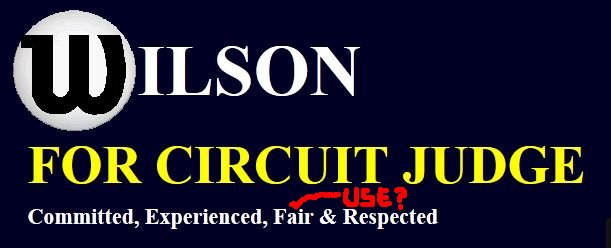
This time it’s a candidate with the last name of “Wilson,” and, you guessed it, he has used what I believe looks like the Wilson sporting goods manufacturer logo as the “W.”
Fair use, or cheap lob shot? (several puns in that caption, let them simmer)
While these may be clever – although not very creative – ways for local candidates to make their names stick in the minds of the voters, is it right? Is this taking advantage of the protection afforded to political speech? For that matter,would this even be protected?
(I wish I could find pictures of the other campaign signs. If any of my readers have interesting campaign signs which use third-party trademarks, please send them to me. I may expand this post in the future.)
The 11th Circuit joined several other Circuits in finding that artistic depictions of trademarks may be protected under the First Amendment. The facts are pretty similar to the “Tiger Woods painting collage” case from a few years ago. There, the 6th Circuit held that artistic paintings of Tiger Woods did not mislead the public as to the source of the paintings, and there was no false endorsement claim.
In yesterday’s 11th Circuit opinion, the Court dealt, in part, with the University of Alabama claiming that paintings of University of Alabama football scenes violated the University’s trademark rights.
Agreeing with the analysis from the Tiger Woods case, the 11th Circuit found that the First Amendment protects this type of artistic work despite the works being for commercial gain. The artist is not intentionally appropriating the trademark for gain. The trademark use is incidental, and consumers are not being misled as to the source of the painting.
Excellent ruling.
Read it HERE. (University of Ala. Bd of Trustees v. New Life, Inc)
(It has been a good month for the First Amendment. Last week, the 7th Circuit held that a South Park parody of the “What What (In the Butt)” viral video was fair use. Read about that, HERE.)
As stated by Walton County Circuit Judge La Porte in January 2012, “Society as a whole is familiar with the emergency number 911 and if you are a custodian of public records you had better become familiar with another number that indicates an emergency-the number 119, Florida Public Records Act.”
Kevin W. Wimberly has been named to the Florida Rising Stars list as one of the top up-and-coming attorneys in Florida for 2012. Each year, no more than 2.5 percent of the lawyers in the state receive this honor. The selection for this respected list is made by the research team at Super Lawyers.
Super Lawyers, a Thomson Reuters business, is a rating service of outstanding lawyers from more than 70 practice areas who have attained a high degree of peer recognition and professional achievement. The annual selections are made using a rigorous multi-phased process that includes a statewide survey of lawyers, and independent research evaluation of candidates, and peer reviews by practice area.
The Rising Stars lists are published nationwide in Super Lawyers magazine and in leading city and regional magazines across the country.
“Immoral, deceptive, or scandalous” trademarks are not eligible for registration with the United States Patent and Trademark Office. See15 U.S.C. 1052 (Section 2(a) of the Lanham Act). Similarly, Florida law bars registration of “immoral, deceptive, or scandalous” marks. SeeFla. Stat. 495.021(a). Such refusals are not that uncommon. In fact, a colleague and former professor of mine, Marc Randazza, has blogged extensively on the subject.
A recent story on WPTV.com out of West Palm Beach brought to my attention a state-based trademark application that was rejected as being immoral. I’m pretty sure this is the first state trademark application that I’ve seen rejected on such grounds. (The state registration system is not nearly as robust as the USPTO’s online system, so it’s difficult to find out how many state applications are refused and under what grounds.)
The applicant operates a restaurant named “fuku,” which, according to the owner, means “good fortune, wealth and prosperity.” (Doesn’t it seem like every Japanese word means good fortune/luck/prosperity?) Apparently the examiner reviewing the application didn’t like the “fuck you” sound and rejected the application. (Again, the state system is crude, so I’m unable to read the actual refusal letter.)
At the federal level, the USPTO has an inconsistent history with “fuku” marks. FUKU-BONSAI was allowed registration. FUKU for clothes probably would have been registered if the applicant had responded to an Office Action. However, FUKU for condoms and retail stores selling adult toys seems to be having some trouble.
According to the news reports, the owner of fuku restaurant plans to appeal the refusal. (Another strategy might be file an application with the USPTO. Federal registration requires interstate commercial use. Depending on the restaurant’s location and marketing [i.e. if it is near a major interstate highway or tourist spot], it may be possible to allege interstate commerce. But, I’m guessing that fuku’s attorney will be able to overcome the state refusal based on the Japanese meaning.)

 Florida IP Trends