Case Update: Yoga Berry Corporation v. Coco Mango, LLC – SETTLED

Well this was anticlimactic.  On August 21, 2012, after a notice of settlement was filed, the Court dismissed the case.  No additional information about the settlement is available, but Coco Mango seems like it’s still in business.

Previous coverage on Florida IP Trends.

Order Dismissing Case with Prejudice

I’ll have to dig around for a new case to feature.

Political Speech – Highly Protected (and infringing?)

It is often said that political speech receives the highest First Amendment protection. In 1976, the Supreme Court in Buckley v. Valeo explained that:

Discussion of public issues and debate on the qualifications of candidates are integral to the operation of the system of government established by our Constitution. The First Amendment affords the broadest protection to such political expression in order “to assure [the] unfettered interchange of ideas for the bringing about of political and social changes desired by the people.” Roth v. United States, 354 U. S. 476, 484 (1957). Although First Amendment protections are not confined to “the exposition of ideas,” Winters v. New York, 333 U. S. 507, 510 (1948), “there is practically universal agreement that a major purpose of that Amendment was to protect the free discussion of governmental affairs, . . . of course includ[ing] discussions of candidates. . . .” Mills v. Alabama, 384 U. S. 214, 218 (1966). This no more than reflects our “profound national commitment to the principle that debate on public issues should be uninhibited, robust, and wide-open,” New York Times Co. v. Sullivan, 376 U. S. 254, 270 (1964).

Sounds great, right? First Amendment principles are behind certain fair use “defenses” to things such as trademark and copyright infringement. (I put “defenses” in quotes because it’s a personal belief that what the First Amendment protects creates a right and not a defense.)

[Before proceeding, I should say that I have no agenda with this post other than to point out something that stuck in my trademark-centric brain on the drive to work. I have no comments or thoughts – positive or negative – about any of the people referenced below.]

The sacredness of political speech is based on the genuine goal of promoting debate and bettering the country. It should not be copyright infringement for a candidate to quote passages from a competitor’s book or to use large portions of an opponent’s radio or TV appearance for the purpose of commentary and criticism. Similarly, using a corporation’s trademark in a parody or campaign to remark on some issue concerning that corporation should fall under fair use.

Given this backdrop, I was surprised a few years ago to see yard signs for a candidate for judge in Orlando. The candidate’s last name was “Schott,” and the signs displayed the last name in a typeface that was virtually identical to the Orlando Magic’s typeface at the time. I’m not positive, but there may have been a basketball or hoop on the sign as well. I have looked for images online but could not find them. I distinctly remember the typeface though, and I distinctly remember equating the sign to the Magic logo, and the wordplay with “Schott” rhyming with “shot,” as in a basketball shot. I also vaguely remember bright yellow and red signs for another local candidate, whose last name was “Wesley.” Those signs made the name “Wesley” look just like the Wendy’s logo.

So why bring that up today? Well, I was reminded of the Schott and Wesley campaign signs this morning on the drive to work. Yes, another candidate has appropriated a corporate logo in a bit of wordplay with his last name.

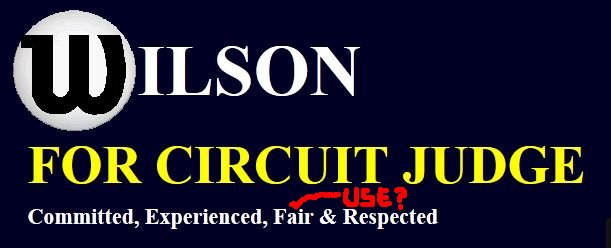
This time it’s a candidate with the last name of “Wilson,” and, you guessed it, he has used what I believe looks like the Wilson sporting goods manufacturer logo as the “W.”

Fair use, or cheap lob shot? (several puns in that caption, let them simmer)

While these may be clever – although not very creative – ways for local candidates to make their names stick in the minds of the voters, is it right? Is this taking advantage of the protection afforded to political speech? For that matter,would this even be protected?

(I wish I could find pictures of the other campaign signs. If any of my readers have interesting campaign signs which use third-party trademarks, please send them to me. I may expand this post in the future.)

First Amendment’s Role in Trademark Infringement Analysis

The 11th Circuit joined several other Circuits in finding that artistic depictions of trademarks may be protected under the First Amendment.  The facts are pretty similar to the “Tiger Woods painting collage” case from a few years ago.  There, the 6th Circuit held that artistic paintings of Tiger Woods did not mislead the public as to the source of the paintings, and there was no false endorsement claim.

In yesterday’s 11th Circuit opinion, the Court dealt, in part, with the University of Alabama claiming that paintings of University of Alabama football scenes violated the University’s trademark rights.

Agreeing with the analysis from the Tiger Woods case, the 11th Circuit found that the First Amendment protects this type of artistic work despite the works being for commercial gain.  The artist is not intentionally appropriating the trademark for gain.  The trademark use is incidental, and consumers are not being misled as to the source of the painting.

Excellent ruling.

Read it HERE.  (University of Ala. Bd of Trustees v. New Life, Inc)

(It has been a good month for the First Amendment.  Last week, the 7th Circuit held that a South Park parody of the “What What (In the Butt)” viral video was fair use.  Read about that, HERE.)

Fuk Who? Fuku.

“Immoral, deceptive, or scandalous” trademarks are not eligible for registration with the United States Patent and Trademark Office.  See 15 U.S.C. 1052 (Section 2(a) of the Lanham Act).  Similarly, Florida law bars registration of “immoral, deceptive, or scandalous” marks.  See Fla. Stat. 495.021(a).  Such refusals are not that uncommon.  In fact, a colleague and former professor of mine, Marc Randazza, has blogged extensively on the subject.

A recent story on WPTV.com out of West Palm Beach brought to my attention a state-based trademark application that was rejected as being immoral.  I’m pretty sure this is the first state trademark application that I’ve seen rejected on such grounds.  (The state registration system is not nearly as robust as the USPTO’s online system, so it’s difficult to find out how many state applications are refused and under what grounds.)

The applicant operates a restaurant named “fuku,” which, according to the owner, means “good fortune, wealth and prosperity.”  (Doesn’t it seem like every Japanese word means good fortune/luck/prosperity?)  Apparently the examiner reviewing the application didn’t like the “fuck you” sound and rejected the application. (Again, the state system is crude, so I’m unable to read the actual refusal letter.)

At the federal level, the USPTO has an inconsistent history with “fuku” marks.  FUKU-BONSAI was allowed registration.  FUKU for clothes probably would have been registered if the applicant had responded to an Office Action.  However, FUKU for condoms and retail stores selling adult toys seems to be having some trouble.

According to the news reports, the owner of fuku restaurant plans to appeal the refusal.  (Another strategy might be file an application with the USPTO.  Federal registration requires interstate commercial use.  Depending on the restaurant’s location and marketing [i.e. if it is near a major interstate highway or tourist spot], it may be possible to allege interstate commerce.  But, I’m guessing that fuku’s attorney will be able to overcome the state refusal based on the Japanese meaning.)

Additional coverage:  HuffPo

Politicians and IP – Still Don’t Mix

Every election cycle some band gets mad that a politician with unwelcome views has used the band’s song during campaign events.  I even blogged about one such instance HERE.

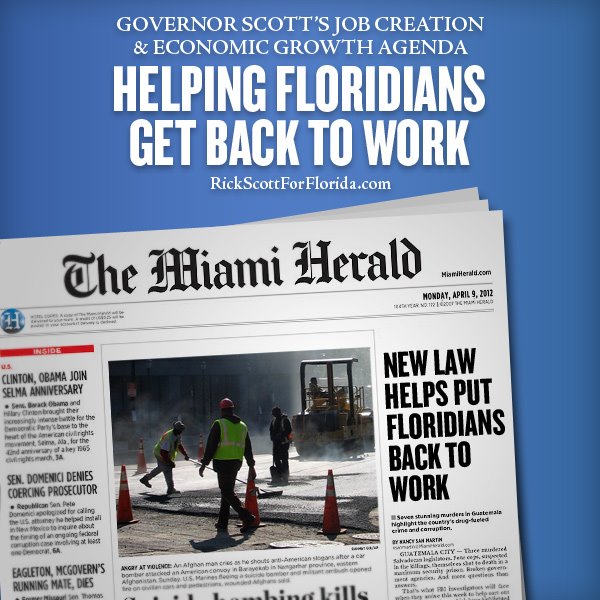
Today’s story is even better.  The Republican Party of Florida (“RPOF”) apparently wanted a favorable front-page headline to promote Governor Scott.  RPOF either couldn’t find one or just thought making one up was easier:

The advertisement:


The problem is that, according to the Miami Herald, it never ran a “New Law Helps Put Floridians Back to Work” story.  In fact, RPOF’s ad agency replaced the true headline (“Murders highlight rise in crime in Guatemala”) and the lead photo from the March 5, 2007 edition of the newspaper.  While political speech is nothing less than sacred under the First Amendment, this is pure deception.


Trayvon Martin – Trademark update

At the end of my post regarding the trademark registration applications that Trayvon’s mother filed, I stated that I had “not seen any statements regarding the intent behind these trademark applications.”

Today, I found a report from Radar Online that the intent behind the applications was in fact to prevent others from profiting.  The quote, attributed to the family’s attorney, states: “Trayvon’s parents will never seek to financially profit from these trademarks, period. I can’t emphasize that point enough.”  Source.

I also checked the status of the applications today, and a preliminary amendment was filed in both applications to correct the misspelling of Trayvon’s mother’s name.

Personal Names of the Deceased as Trademarks

Central Florida has been in the national news for more than Mickey Mouse and Dwight Howard recently.  The Casey Anthony trial riveted the nation and brought scores of news crews to Orlando.  From Nancy Grace to Geraldo Rivera, there was no escaping the “tot mom” and her “Bella Vita” tattoo.  Tragically, Central Florida was in the news for all the wrong reasons.

That trend continues.  As with the homicide of Caylee Anthony, the death of a child has once again brought national attention to Central Florida.  Trayvon Martin was shot dead while walking to his house after buying some ice tea and Skittles candy at the nearby convenience store.  The killer, George Zimmerman has claimed self-defense.  Zimmerman is (or was) involved in the Neighborhood Watch program, and he is reported to have a history of calling 911 to report “suspicious” incidents. One reason that this case has brought so much attention is because the local police did not arrest Zimmerman after the shooting.  The police indicated that they had no probable cause to dispute Zimmerman’s statements that he shot Trayvon in self-defense.

But this post is not about the guilt or innocence of either of these accused murderers.  One had her day in court, and the other should get the same “opportunity.”

This post is about the families of the deceased filing trademark applications.  It’s a sad thought.  Rather than Caylee Anthony or Trayvon Martin becoming business owners themselves, needy for trademark protection, their families have filed trademark applications after their deaths.

For Caylee, the trademark applications were filed by her grandparents’ attorney.  In fact, the applications claim that the trademarks are owned by the attorney.  The applications are for “CAYLEE ANTHONY” and “JUSTICE FOR CAYLEE.”  The goods that are listed in the applications include t-shirts, underwear, and buttons.  The applications were filed as “intent-to-use” applications, which means that the applicant had to declare that he intended to use the trademarks in a bona fide offering of the goods.

When news of this got out, many people accused the Anthonys of “cashing in” on the death of Caylee.  While this was most likely a knee-jerk reaction – surely the Anthonys wouldn’t be trying to profit from the death of their granddaughter – there is some legal merit to the charge of cashing in.  This is because trademark law is a creature of the Commerce Clause in the United States Constitution.  The Commerce Clause enables Congress to regulate interstate commerce.  As such, federal trademark registration is only available to those who seek to use a trademark for interstate commercial purposes.

However, as explained in the previous link, the Anthonys filed these trademark applications in order to prevent others from cashing in.  In that respect, they were “defensive” trademark applications.  The fact that a federal trademark applicant must declare that they either are using or intend to use the mark in interstate commerce makes this practice of “defensive” trademark applications a very interesting topic, but it is beyond the scope of this post.

This post is focused on the fact that the Caylee Anthony trademark applications, and the ones described below, both involve personal names.  I have blogged about this issue before.  In order to register a personal name as a trademark, the applicant must disclose whether or not the trademark refers to a living individual.  If so, the applicant must state whether or not the individual has provided consent to use his or her name in the application.

The Trademark Manual of Examining Procedure (“TMEP”) explains:

If a mark comprises the name or likeness of a living individual and consent to register is of record, a statement to that effect must be printed in the Official Gazette and on the registration certificate.

http://tmep.uspto.gov/RDMS/detail/manual/TMEP/Oct2013/d1e2.xml#/manual/TMEP/Oct2013/TMEP-800d1e2550.xml

Similarly, if the trademark is a name but does not depict a living individual, a statement to that effect must be made:

If a name or likeness that could reasonably be perceived as that of a living individual is not that of a specific living individual, a statement to that effect must be printed in the Official Gazette and on the registration certificate. The statement should read as follows:

“__________ does not identify a living individual.”

The applicant should explain any additional relevant circumstances. For example, if the matter identifies a certain character in literature or a deceased historical person, then a statement of these facts in the record may be helpful, but this information will not be printed in the Official Gazette or on the registration certificate.

http://tmep.uspto.gov/RDMS/detail/manual/TMEP/Oct2013/d1e2.xml#/manual/TMEP/Oct2013/TMEP-800d1e2550.xml

Unfortunately, the attorney who filed the Caylee Anthony applications did not make the appropriate statements concerning the life or death of the person referenced in the applications, Caylee Anthony.  The Examining Attorney from the USPTO therefore issued an “Office Action” which required that the applicant fix the error:

 The applied-for mark includes a name that may identify a particular famous or historical individual who is deceased.  Specifically, the mark includes the name “CAYLEE.”  Where a name, portrait or signature in a mark identifies a particular living individual, the mark can be registered only with the written consent of that individual.  Trademark Act Section 2(c), 15 U.S.C. §1052(c); TMEP §813; see TMEP §§1206 et seq.  In this situation, where it is unclear whether the name, portrait or signature is that of a living individual, applicant must so clarify for the record.  See TMEP §§813.01(b), 1206.03, 1206.05.

Accordingly, if the individual identified in the mark is in fact deceased, applicant should provide the following statement: 

The name, portrait, or signature shown in the mark does not identify a living individual.

See TMEP §§813.01(b), 1206.03, 1206.05.

If the name or signature in the mark does identify a particular living individual, then applicant must submit the following:

(1)  A statement that the name “CAYLEE” identifies a living individual whose consent is of record.  If the name represents that of a pseudonym, stage name, or nickname, applicant must include a statement that {specify fictitious or assumed name} identifies the {indicate pseudonym/stage name/nickname} of {specify actual name}, a living individual whose consent is of record; and

(2)  A written consent, personally signed by the individual whose name or signature appears in the mark, authorizing applicant to register the name, pseudonym, stage name, nickname, or signature as a trademark and/or service mark with the USPTO (e.g., “I consent to the use and registration by Lippman Law Offices, P.A. of my name “CAYLEE” as a trademark and/or service mark with the USPTO”).

TMEP §§813, 813.01(a), 1206.04(a); see 37 C.F.R. §2.61(b).

See Office Action, HERE.  That was no doubt a sad piece of mail for the Anthonys’ attorney to open.  These applications were filed well after Caylee’s remains were found, and it’s unfortunate that the appropriate statements concerning the life or death of the person depicted in the trademarks weren’t made in the application.  Interestingly, the 6-month period in which to file a reply to the Office Action has passed, so the Examining Attorney should be marking the applications as “abandoned” in the near future.  It is not a stretch to think that these applications were simply filed to give the Anthonys’ attorney a federal application number to use in cease and desist letters which were no doubt sent to the people who truly were seeking to cash in on the Casey Anthony trial.  With the heated emotions dying down, and opportunists turning to a fresher news cycle, there may simply be no need for the CAYLEE ANTHONY and JUSTICE FOR CAYLEE trademarks anymore.

Image originally found on MSNBC.com. Used for educational and commentary purposes.

This brings us to today’s news about Trayvon Martin.  His mother, Sybrina Fulton, has filed two trademark applications using her son’s name.  The applications are for JUSTICE FOR TRAYVON and I AM TRAYVON.  As with the Caylee Anthony applications, these applications are intent-to-use applications, and the goods include DVDs, CDs, and other media. (This is also beyond the scope of this article, but as shown in the above picture and on the local news story I just saw, which included interviewing a man selling “Justice for Trayvon” t-shirts, there may actually be people that have already made a commercial use of the JUSTICE FOR TRAYVON and I AM TRAYVON trademarks.  If so, those people might have a superior common law claim to the trademark rights than Trayvon’s mother.)

Sadly, the attorney that filed the Trayvon Martin applications also failed to indicate whether or not “Trayvon” is a living or deceased individual.  (It also appears that Sybrina’s name was misspelled in the applications.)  The fact that such “living or dead” statement was not made means that 3 or 4 months from now, Trayvon’s mother’s attorney will be getting that same piece of mail requesting further information about the status of Trayvon Martin’s life.

As with the Caylee Anthony trademark applications, there has been a public backlash against this alleged attempt to “cash in.”  Comments in stories such as THIS one (“Nothing like cashing in. I bet Al Sharpton helped her fill out the paperwork”) and THIS one (“grieving all the way to the bank”), made by the oft-ignorant people hiding behind Internet screen-names, show a) a lack of class, and b) a lack of understanding that these applications may be “defensive” and designed to prevent others from doing the very thing that Trayvon’s mom is being accused of – cashing in on the death of her son.

While I have not seen any statements regarding the intent behind these trademark applications, it would not be the first time that the family member of a murder victim has filed trademark applications to stop others from profiting from the tragedy.  And, frankly, even Trayvon’s mother does want to offer DVDs and CDs under the JUSTICE FOR TRAYVON and I AM TRAYVON trademarks, why does that erase any sympathy and support for a mother grieving the murder of her son?

I’ll keep an eye on these applications and post a follow up when there’s something to report.
It’s déjà vu all over again

Trade dress cases are fun.  Trade dress typically refers to the visual appearance of something – such as a product’s packaging or the design of the product.  The shape of a Coca-Cola bottle is an example of trade dress.  When you see that distinctive bottle shape, you immediately think of the source, Coca-Cola.

One of the more popular trade dress cases (at least in Florida) was the “Hooters v. Winghouse” case.  There, Hooters’ parent company sued the company behind the Winghouse chain of restaurants.  Hooters claimed that its trade dress was “the Hooters Girl uniform; rough-hewn rustic interior woodwork, including light colored wooden walls and floors; dining tables consisting of red wood of varying hues, surrounded by lighter pine wood, and covered with a shiny epoxy; a table-top setup consisting of a wooden vertical paper towel
spool, wood-weave plateware, and table tents; a parchment paper menu bearing the story of the restaurant on its reverse side; surfboards; wall-mounted photographs of celebrities taken with servers; pictures of girls in attractive swimwear; road signs displaying clever sayings; hula
hoops; large-bulb Christmas lights; wall-mounted sports memorabilia; bumper stickers; and “beachy” music from the ‘50s through the ‘80s.

However, the court in that case focused on the very first item in that list – the Hooters Girl uniform.  Ultimately, the court found that the Hooters uniform is “functional,” and to deny another business from being able to use waitresses in shorty-shorts and tank tops would be an “impermissible burden on competition.”  Thus, you now have two places to go get wings and see girls in tiny outfits.  You just need to choose if you prefer orange/white uniforms or black/red.

Now that you have an idea about what trade dress is, Florida IP Trends presents:

Yoga Berry Corporation v. Coco Mango, LLC [COMPLAINT]

This case got my attention because of the “Yoga Berry” plaintiff.  My first thought was that famed catcher Yogi Berra must have gotten into the health nut business or something.  But no, there does not seem to be a relationship between Yogi Berra and Yoga Berry (although I cannot confirm or deny it).  That makes this a somewhat unsympathetic plaintiff for me.  Before even reading the complaint I was thinking, “Gee, if these guys are trading on the name of the great Yogi Berra, what beef do they have with Coco Mango?

Well, the beef is in the yogurt.  [author’s attempt at a Yogiism]

Yoga Berry is suing the operator of a “Coco Mango” yogurt store.  Yoga Berry alleges that Coco Mango copied the distinctive trade dress found in the YOBE yogurt stores.

Yoga Berry has a tough hill to climb.  Just as Hooters learned that even a distinctive and well-recognized decor can ultimately fail as trade dress, Yoga Berry will have to prove that its trade dress is protectable.  The Complaint could be a little clearer in defining the trade dress, but it looks like a YOBE store has “futuristic white stools, chairs, table, and benches,” and “distinctive light fixtures” among other things.  Pictures or exhibits would have been nice in a complaint like this.  (I’m sure the judge would have appreciated them, too.)  However, since there were none, I took the opportunity to find some.  Having never been in either store, I just couldn’t picture what the Complaint was trying to show.

YOBE Store