There has been a lot of interest in this case, so I figured I would give Florida IP Trends readers an early Christmas present by uploading recent documents from the case.
A hearing was held in Miami yesterday, and it appears that Mr. Link/Lang was not in attendance. In his absence, the judge granted a temporary restraining order (TRO) which essentially kills Mr. Lang as played by Mr. Link. Oddly, the Motion for Temporary Restraining Order is sealed, so I’m unable to see the arguments and affidavit from Steve Budin that resulted in the judge granting the TRO. There is a hearing set for December 30th to show cause on why a preliminary injunction should not be ordered. A preliminary injunction would essentially extend the TRO so that the same prohibitions are in place during the case (i.e. Mr. Link is prohibited from using the BRANDON LANG trademark).
Note that this is not the end of the case. The merits of the case have not even been addressed. All of the activity thus far has been trying to stop Mr. Link from portraying himself as Mr. Lang while the case progresses. An Answer hasn’t even been filed.
So, it will take more time to solve mystery of who signed the “Brandon Lang” consent statement in the trademark application. (Which, coincidentally, was signed 3 years ago this Sunday.)
This one is a real headscratcher. I have to make an initial disclaimer before diving in – my firm is currently representing a defendant in an unrelated case brought by the same plaintiff in this case. This post reflects my personal opinions and is not related to any issues in the case I’m working on with the firm.
With that said, Florida IP Trends presents:
Stevo Design, Inc. v. Brandon Link, Case No. 1:2010cv24283 (SDFL December 1, 2010)
According to the complaint, “Stevo Design provides sports handicapping services. In general, handicapping is the practice of assigning advantage through scoring compensation or other advantage given to different contestants to equalize the chances of winning…Stevo Design operates over 7 internet-only sports handicapping brands, and services over 10,000 unique clients worldwide. This is accomplished online via pay-per-view sports analysis and selections, or what is commonly known as providing ‘Sports Picks’. Stevo Design employs more than 15 full-time sports handicapping professionals to analyze games and sporting events on a daily basis throughout the year and deliver their opinions and rated selections to clients.”
Several years ago, a movie was made about the world of sports handicappers. The film was called Two for the Money, and it starred Al Pacino, Matthew McConaughey, and Rene Russo. One of the main characters was based on a Stevo handicapper named Brandon Link. As far as I know, Brandon Link is Brandon’s real name. However, in the movie, Mr. Link is named “Brandon Lang.”
Sensing marketing opportunities, Stevo submitted a service mark application to the U.S. Patent and Trademark Office (“USPTO”) for the mark “BRANDON LANG” for the following services: “Handicapping for sporting and other entertainment events.” The application was submitted March 15, 2007, and a registration ws issued on June 17, 2008. The registration information may be viewed HERE.
It’s somewhat rare, but not unusual, for a living person’s full name to receive a trademark registration, but given the obvious boost in visibility that the movie would bring to Stevo’s services, it makes sense that Stevo would want to protect the Brandon Lang “brand.” Following the success of the movie, Brandon Link continued offering his handicapping services under the Brandon Lang name.
As alleged in the complaint, at some point the relationship between Brandon and Stevo broke down. The details are in the complaint, but ultimately, the parties decided to part ways. They signed a separation agreement, and one of the counts in the complaint is based on Brandon’s alleged breach of that agreement.
The reason that the case is appearing on Florida IP Trends is because of the unique trademark infringement issue – specifically, infringement of the registered BRANDON LANG mark. The infringement is allegedly based on Brandon’s use of the BRANDON LANG name in providing handicapping services and in the use of Brandon’s website, which is located at www.therealbrandonlang.com. Stevo runs www.brandonlang.com. [12/7/2010 UPDATE: I noticed that one of the search terms used to hit Florida IP Trends was “brandon lang, website cancelled” so I checked out both sites. It does appear that therealbrandonlang.com is currently down. Perhaps settlement talks are underway.]
Brandon Link/Lang
Sharp readers are probably scratching their heads at this point. That’s right, The case is Stevo Design v. Brandon Link. Brandon Lang is a fictional character in a movie. (I couldn’t find any fictional name/dba’s in the Florida Secretary of State records.)
So, doesn’t Stevo still have the right to prevent others from offering services under a trademark registration owned by Stevo? Absolutely. But here’s the problem. In order to obtain a trademark registration for a personal name, the applicant must inform the USPTO if the mark does indeed identify a particular living individual, and if so, then that living individual must submit a signed consent statement indicating that he or she consents to their name being used in the trademark application.
As THIS document shows, on June 23, 2007, the USPTO Examining Attorney followed proper procedure by asking Stevo if Brandon Lang was a living individual, and if so, then a consent form was required. If Brandon Lang was NOT a living individual, then Stevo was supposed to reply as such.
Responding three days past the six month deadline for a response, on December 26, 2007, Attorney Mark Jordan submitted a signed consent form from “Brandon Lang.” You can view the form HERE (see page 3).
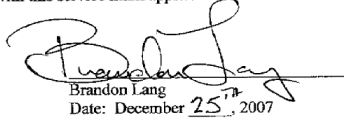
Say huh? Sure as heck, on Christmas Day, 2007, one “Brandon Lang” signed his name to a form indicating that he consented to his name being used in the trademark application.
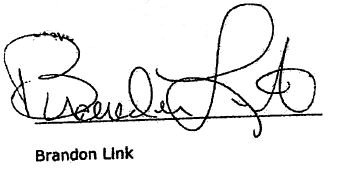
I’m no Columbo, but I had a hunch. Luckily, one of the exhibits to the Stevo v. Link complaint is the separation agreement signed by Brandon Link. Let’s compare Mr. Link’s and Mr. Lang’s signatures:
Rut-ro. I’m also no handwriting expert, buuuuuuut…..
So here’s the problem. If there is no living individual named Brandon Lang, and Stevo (or the attorney handling the application) knowingly submitted a document that [cringing] falsely [/uncringing] represented that Mr. Lang does exist, then the entire trademark registration is at risk. That means canceling the registration – or perhaps the registration would be void. That means no trademark infringement as to the registration.
Stage names are registrable with the USPTO, but the “real” person should – or at least typically does – sign their real name on the consent form. For example, Mario Lavandeira signed the consent form in the trademark application for his stage name, “Perez Hilton.”
This is a fascinating issue – a real person signs the name of a fictional character loosely based on his own persona in an attempt to register the fictional character’s full name as a trademark.
Ultimately, if the trademark registration is canceled, I think hindsight will show that a simple response to the Examining Attorney’s June 23, 2007 office action indicating that “Brandon Lang is a fictional character” and/or having Brandon Link sign his real name for the “Brandon Lang” pseudonym would have prevented this entire mess.
Big thanks to my mom for alerting me to this new development:
We will not have a USC v. USC at the U.S. Supreme Court. As previously blogged here, the University of South Carolina and the University of Southern California duked it out on a trademark issue recently, with the REAL USC (South Carolina) taking a shiner.
As reported by the Associated Press, the Supreme Court has declined to hear the case, thus leaving in place the Federal Circuit’s decision that prevents USC (the real one) from obtaining a federal trademark registration for its own “SC” logo. See WIS-TV story here.
Note – the story states that “Courts have rejected South Carolina’s trademark.” NO, NO, NO, NO, and NO!!! The United States Patent and Trademark Office rejected South Carolina’s trademark application. South Carolina can still use the logo as their trademark – they simply cannot get the benefit of federal registration. And while we’re on the “what makes an anal IP attorney cringe” kick, don’t use “trademark” as a verb. Ever. You do not “trademark” something. People typically mean “apply for a trademark registration” when they use trademark as a verb.
I’ve been made aware that Invicta has actually filed suit against Plasticase now. (See THIS POST for the back-story.) I haven’t had a chance to review the pleadings in depth, but the complaint is based on Plasticase’s alleged “false marking” of its cases. False marking occurs when someone marks an item as “Patented” when, in fact, it is not covered by a patent. See statute HERE.
False marking is the current hot topic in patent law since there is uncertainty over whether the false marking statute allows for a penalty based on each individual item that was falsely marked or whether the penalty applies to the occurrence (i.e. a single penalty for an entire manufacturing run). Also, the statute allows anyone to file suit, so suing under the statute is like a new flavor of patent trolling.
There are potential trademark dilution issues here (Star Wars and Star Trek), but you have to respect a dentist who calls his practice “Starbase Dental.”
I first wrote about this case in January, shortly after the complaint was filed. Just checked PACER for any updates, and, Wow! This one is getting expensive quickly!
As I noticed, the attorney who filed the case wasn’t admitted to the Florida Bar, and the defendants’ attorneys pointed that out in the first motion to dismiss. Yes, I said their first motion to dismiss. Three months in, and we already have two motions to dismiss with two orders! (Local counsel has now appeared, and the original attorney has been admitted temporarily for this case.)
While I called the complaint a “doozy” in my original post, the judge gave it the kiss of death by calling it a shotgun pleading (fitting for an outlaw?). This is a style of drafting a complaint where each claim incorporates all of the factual allegations preceding the claim. Many complaints are drafted this way despite the fact that they are improper. For example, if the second and third claims in a complaint both re-allege all of the preceding factual allegations, then the defendant technically doesn’t know which allegations belong to a specific claim – and that violates the federal rules of procedure.
The defendants’ attorneys picked up on this (and other issues in the original complaint) and filed a short and sweet motion to dismiss. The judge agreed (on the same day!) and gave the plaintiff permission to file an amended complaint.
Guess what happened? The plaintiff must have had a double-barreled shotgun because they did it again! Not only that, but they also added on this nugget – which makes a First Amendment attorney such as myself cringe. In the prayer for relief, the plaintiff has asked that the court to:
Order all Defendants to abstain from in any way discussing, commenting upon, or mentioning Plaintiffs in this action in public, in performances, or in any other public venue;
What!? So, plaintiff wants, say, Henry Paul, to be legally prohibited from mentioning not only the case, but the mere existence of Outlawlessness Productions in public?
Interest in this case has been very high, so I’m going to update it more often than most cases.
Invicta was served with the Complaint on April 8th. An answer or other motion tolling the time to answer should be filed in the next couple of days.
Apparently Invicta’s registered agent (the person listed with the Florida Department of State as responsible for accepting a summons) is deceased, so Invicta’s “Financial Controller” accepted service of the complaint.
Invicta’s corporate information via the Department of State showing David Feldman as registered agent.
Invicta evokes a polarizing response from “watch geeks.” Some appreciate the value-priced quality while others sniff that Invicta is merely a “TV brand” due to its ubiquitous presence on ShopNBC. Still others delight in the (fictional) misfortunes of its CEO from disgruntled purchasers. More recently, Invicta has been blazing a trail in the oversized watch market. (For reference, the typical Rolex “Submariner” style dive watch case is about 40 millimeters. Invicta is now regularly producing watches with cases over 50 millimeters in size and 20 millimeters thick.)
Video capture from 4/11/2010
Me – I’ve grown tired of the typical home shopping TV doublespeak. “One time only” prices that magically get lower the next month; “limited editions” that are offered again and again with slight deviations in design; a “Reserve” line that was supposed to be, uh, reserved, for extra-premium timepieces that now cost less than the non-Reserve line. I could go on. And on.
The Invicta shows on ShopNBC do make for an entertaining evening at home. Whether it’s the host’s thinly-veiled, juvenile jokes about “brown eye” dials and “slapping a beaver” on your wrist, or the feigned astonishment and gasps that precede “that price must be a mistake,” you can’t beat live home-shopping TV.
So I might be biased as I write about this new lawsuit against Invicta. I take it personally. Invicta’s CEO, Eyal Lalo, seems to be a pretty ethical guy. Back when the host of ShopNBC’s watch shows was known as “OompaLupah” on a watch forum that I frequented, Eyal personally responded to customer questions and even sent a bunch of us a fancy Invicta watch box. (I’ll sell mine to anyone interested if the price is right…)
Eyal also constantly remarks about how he is the named inventor on multiple patents covering the designs of Invicta watches. He recognizes the importance of patents, and he should. The Invicta Lupah design is widely copied by other manufacturers.
So, that’s why reading this Complaint is so tough. Despite my love/hate relationship with Invicta and its marketing channels, I tend to support the brand overall.
A few months ago they started selling a new watch design with several interchangeable straps and bracelets. The whole thing was packaged in a “submarine case.” If my memory is correct, they also use a little animation that looked like a CAD drawing of the case opening up to reveal the watch and straps. They also offer the case by itself, and I believe that several other Invicta models are shipped out in this style case now.
Imagine my surprise, then, when I saw:
Plasticase, Inc. v. Invicta Watch Company of America
Damn. The case was filed April 6, 2010 in the United States District Court for the Southern District of Florida.
The allegations are straightforward. Eyal calls company to see about having some plastic storage cases customized for use with watches. Company sends sample cases to Eyal. Eyal never responds with an order or “no thanks.” Company sees its patented case design on national TV. Company calls Eyal to see if he intends to order any cases based on the samples. Eyal says he is “passing on the opportunity.” Oops.
If true, the allegations paint a very disappointing picture of this watch company and its charismatic CEO. Plasticase is basically saying that Eyal ordered some sample cases then, rather than order from the company that designed the cases, he shipped them off to China to have them made cheaper.
As you already know from reading this blog, fairly recent changes have occurred in the infringement analysis for design patents. In a “knockoff” case like this, the patentee-friendly Egyptian Goddess standard might not even matter. If the case doesn’t settle soon, Plasticase should get everything it needs for a slam dunk via discovery requests. Invoices from China and Eyal’s own conduct in ordering the samples is 80% of this case. Add in plaintiff’s design patents and proper marking of the cases, and this should be over.
Of course, Invicta hasn’t answered yet, and the Complaint is obviously slanted to one side. Invicta is innocent until proven guilty. This is definitely one case that I’ll be following with interest.
I’ll even make this deal – if the case goes in Plasticase’s favor on summary judgment or via a jury verdict, via multiple choice, I’ll let my readers choose the fate of one of my Invicta watches, and I’ll post a video of the destruction.
One of the very first cases featured on Florida IP Trends was International Seaway v. Walgreens, in which Walgreens was sued for some allegedly infringing Crocs-like shoes (original post HERE).
The case involved design patent infringement and was one of the first cases in Florida to handle the Federal Circuit’s Egyptian Goddess opinion.
This is text from my original post. I thought the Southern District misapplied the Contessa precedent:
In addition to that technicality(?), I think the court missed the overall point of Contessa. The court used Contessa to justify excluding the insoles of the sandals from the comparison of the designs. The reasoning was that “when a shoe is in use, it’s[sic] insole is, obviously, hidden by the user’s foot…[a]s such, this Court will not consider any aspects of the insoles of the shoes, but will consider the sole of the shoes as those are visible during use.” Uh, except when someone happens to be WALKING ON THE SOLES!
The Court also stated that “the law requires a court to consider only those portions of the product that are visible during normal use, regardless of whether those portions are visible during the point of sale.” While this might be true, in the case of Crocs-like shoes, I believe that the sole and insole are both visible during normal use – INCLUDING at the point of sale. All of the Crocs and Crocs-like shoes I’ve seen for sale are hanging on a rack without boxes, thus, all sides and features are visible. Because a feature that is more visible at the point of sale might be less visible later does not mean that the feature should be excluded. Contessa said that the analysis should include “all ornamental features visible at any time during the normal use of the product.” (emphasis added). To me, this would include when the owner has the sandals sitting next to him or her on the beach, in which case the insole would be visible.
So, imagine my delight when I found out that on December 17, 2009, the United States Court of Appeals for the Federal Circuit agreed! (Fed. Cir. opinion HERE.) Note that appeals of patent cases go directly to the Federal Circuit – that’s why we’re not discussing the 11th Circuit here. (I also have to apologize for letting this slip through the cracks for so long. I honestly missed the appeal. I found out about it at the Florida Bar 1st Annual IP Symposium last week in Tampa.)
From the Federal Circuit’s opinion:
The district court here misconstrued Contessa as requiring that the normal use of a clog be limited to the time when it is worn. Contessa did not exclude the point of sale from the normal use of a product. Rather, it emphasized that normal use should not be limited to only one phase or portion of the normal use lifetime of an accused product. Id. at 1380 (citing KeyStone Retaining Wall Sys., Inc. v. Westrock, Inc., 997 F.2d 1444, 1450 (Fed. Cir. 1993)). The sale of a clog occurs after it has been manufactured and before it is ultimately destroyed. Thus, the point of sale for a clog clearly occurs during its normal use lifetime. At the point of sale, the insole is visible to potential purchasers when the clog is displayed on a shelf or rack and when the clog is picked up for examination. Similarly, removing a clog from a wearer’s foot also occurs after manufacture and before destruction of the clog, so it also falls squarely within the clog’s normal use lifetime. The wearer may remove the clog temporarily to stretch out his or her toes, leave the clogs on the beach to go for a swim, or engage in countless other activities that would leave the insole exposed.
Ok, who thinks the appellate court reads Florida IP Trends? Me neither, but it’s still great to see the same analysis show up in the appellate opinion!
Well, who couldn’t have seen this coming. The earlier story regarding how Lake Mary High School basically ripped off the Chrysler ram logo has been updated. The new info is this: Lake Mary High will not have to immediately change all of the logos. Instead, Lake Mary High will become a “Proud Partner of Chrysler.” No word yet on whether Shell or Sunoco will be the official fuel.




 interchangeable straps and bracelets. The whole thing was packaged in a “submarine case.” If my memory is correct, they also use a little animation that looked like a CAD drawing of the case opening up to reveal the watch and straps. They also offer the case by itself, and I believe that
  Florida IP Trends