Floridians still 3rd most active TM filers, but volume is down

The USPTO just issued their Performance and Accountability Report for Fiscal Year 2009.  (The trademark statistic tables start on page 126 of the Report.)

I previously posted the FY2008  statistics for Floridians filing trademark applications, and here’s the update.:

California 58,643  (2008 was 68,039)
New York 28,383  (2008 was 31,965)
Florida 18,730  (2008 was 21,973)
Texas 15,933  (2008 was 17,258)

Overall, U.S. residents filed 274,603 trademark applications in FY2009 (2008 was 314,510).

This looks like a pretty substantial decrease, and I think the logical reason points to the economy.

BONUS FACT:  Can you guess which foreign country files the most applications?  Volkswagen Group, BMW Group, Siemens, DaimlerChrysler, BASF…  Yep, Germany.  Germans filed 11,345 U.S. applications yet only received 4,409 registrations.  That’s a relatively high failure rate.  Any ideas why?

The Obama Bag

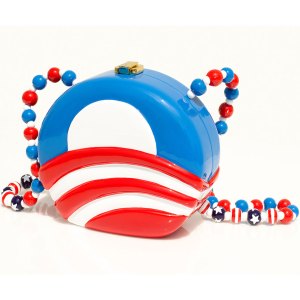
obamabagAs mentioned in the Featured Case post, when I was exploring the Timmy Woods website to look for the allegedly infringing snowman purse, I noticed that Ms. Woods has also designed “The Obama Bag,” which can be yours for the low price of $375.

I’ve always been a fan of the “O” logo, and I was amazed at the “adaptability” of the logo throughout the Obama campaign.  Whether it was adding a rainbow flag (gay/lesbian) or notebook paper (students), it seems that every “special interest” group (self-defined or otherwise) was able to adapt the logo to fit that group’s interest.

As a trademark attorney, I naturally had to ask, is this ok?  From the Timmy Woods purse to the thousands of online vendors selling t-shirts, magnets, mouse pads, etc. – none of it seemed connected to the official campaign.  Perhaps this is a new phenomenon.  I see the reverse situation happen all the time:  Local or national political candidate “borrows” a popular ad campaign for his or her own use.  In the case of Ralph Nader using MasterCard’s “Priceless” campaign, a court found that Nader’s use constituted “fair use” and did not infringe MasterCard’s intellectual property.  (For more on that case, including the court’s decision, CLICK.)

But the Obama logo is different, this logo was designed by professional artists, and it is the people who claimed it as their own rather than a politician swiping something already embraced by the public.  (For a fascinating video interview with Sol Sender, design lead for the team developing the logo, check out this site.  The interview shows the design progression for the logo and how/why it’s different than the usual campaign slogan.)

With the rampant use of the logo, I had always wondered who, if anyone, owned it.  Once I saw the Timmy Woods purse, I had to investigate.  Lo and behold, “Obama for America” has a federal trademark registration for the logo!  The application was filed on 5/17/2007 and was registered on 12/2/2008.  The registration covers a myriad of products: bumper stickers, DVD’s, jewelry, mugs, water bottles, clothing, and other goods/services.

Along with ownership and registration of a trademark comes a responsibility that the owner protect the mark from unauthorized uses.  One consequence of failing to do so is called “naked licensing.”  Naked licensing occurs when the mark owner gives an express or implied license to another person so that that person can also use the mark, but the mark owner then fails to control the quality of the goods on which the marks was placed.  See Doeblers’ Pa. Hybrids, Inc. v. Doebler, 442 F.3d 812, 823 (3d Cir. 2006).  The result of naked licensing is that the mark owner will be deemed to have “abandoned” the trademark, thus losing rights in the mark.  Essentially, the mark loses its ability to identify a single source as controlling the goods.

Barack Obama’s official campaign website, http://www.barackobama.com, contains a “Downloads” page that allows anyone to download the “O” logo.  At the bottom of the page, the following text appears:

By downloading the Obama for America (“OFA”) logo from this site, you agree that you will use the logo only for your personal, non-commercial use. You cannot market, promote, sell, or exchange anything that bears this logo. To avoid having to register with the FEC, you should limit your printed flyers, posters, or other materials for any event to 500 or fewer.

This looks like a license to me.  The owner of the trademark, Obama for America, is granting the use of the logo in exchange for the user’s agreement to not “market, promote, sell, or exchange anything that bears [the] logo.”  (Wow, you can’t “exchange” anything bearing the logo?)  Since a finding of naked licensing results in abandoning the mark, the burden of proof is high, but it seems like there is rampant naked licensing of the O logo – at least with respect to people who may have created products from logos downloaded from the official webpage.  For those people that sourced the logo elsewhere and then created goods with the logo, my guess is that they might just be “regular” trademark infringers.  For those people, perhaps the uncontrolled use by the licensees could result in an abandonment of the trademark registration such that everyone – regardless of where they obtained the logo – might have a decent defense.  At that point, would the mark still be strong enough for the owner to assert common law rights?

Obviously, this is all academic because what are the chances that Obama for America will start litigating?  I do think it’s an interesting issue, and I would love to see some comments from readers.  Should Obama for America have even sought federal registration?  If Obama detractors use the logo in a negative way, would it be hypocritical to sue the detractor and not someone like Ms. Woods who used the logo as an apparent “fan” of the campaign?  Should all political slogans and logos be public domain for all – free for commenting, criticizing, and profiting?

"Logobama" created at logobama.com

Floridians 3rd Most Active in Trademark Applications

This report came out in November ’08, but it’s worth a brief mention.

According to the USPTO’s Performance and Accountability Report for Fiscal Year 2008, Florida residents filed the third highest number of trademark applications in 2008.

California  68,039
New York 31,965
Florida  21,973
Texas 17,258

Overall, U.S. residents filed 314,510 trademark applications.  Obviously, not all of these will mature into registrations, but that’s a LOT of branding!

Latin Hooters

Last week I wrote about Florida’s love of boats.  This week, it’s hooters Hooters.  RAISINSI’m sure it’s the same all over the U.S.A., but Hooters (the restaurants) are all over Florida.  Just last week I went to Daytona for a car show, and Hooters was there selling wings, soda, and fun.  Before I had even handed over my two dollars for a warm can of Diet Coke, an “I Love Hooters” sticker had been slapped on my chest.  It reminded me of my favorite South Park episode in which Butters falls in love with his “RAISINS” waitress because she showers him with affection at the restaurant – at least until he ran out of tip money…

Florida is also the place where WingHouse spanked Hooters in a trade dress infringement case, so a Hooters post is definitely at home on Florida IP Trends.

As an IP attorney, I have a disease that has altered my brain into constantly scanning for trademarks – infringing or otherwise.  While most people scan signs and billboards for information (such as STOP, YIELD, etc.), I’m looking for the registered trademark symbol.  It’s ridiculous.  If I see a somewhat-descriptive mark with the “circle R” symbol, I’ll turn to my wife and say “Must be on the Supplemental” to which she replies, “You’re a dork.”  Point taken, but 9 times out of ten when I get back home and search the USPTO TESS database, I’m right.Latin Hooters

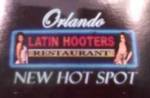
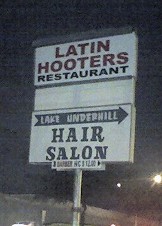
Latin HootersSo, imagine my udder utter delight when I saw this sign: LATIN HOOTERS.  Oh yes – there is a LATIN HOOTERS restaurant on Lake Underhill Drive in Orlando.  When I first saw it I got giddy with the possibility of a Hooters v. Latin Hooters fight.  I have seen at least one (old) cease and desist letter sent by Hooters asking for the removal of a picture of a customer with some Hooters waitresses from a website.  Surely LATIN HOOTERS is on the radar.

Well, this was all several months ago – in fact – it may have been a year since I took these pictures with my cell phone.  I didn’t think much of it until today when I saw the sign again.  So, I fired up the TESS database, and sure enough, LATIN HOOTERS filed a trademark application.  Ouch.  This is a surefire way to bring the wrath of the owner of a famous brand.  It’s like mailing a letter to corporate counsel asking for them to check out your potentially infringing business.  Most people don’t realize that companies with a valuable IP portfolio are actively monitoring trademark applications for potentially infringing marks.  They have to – there can be legal penalties for failing to police or monitor your registered mark.  Example:  Ever thought about filing an application for a mark that contains the word “Monster?”  Good Luck.

The word mark application is for “LatinHooter’s” (with an apostrophe), for “bar and restaurant services.”  The application was filed on 5/10/2008, and an Office Action was mailed out 8/26/2008.  No response has been made, but the (pro se) Applicant has until 4/26/2009 to respond.  Predictably, the Office Action is a refusal to register “LatinHooter’s” based on a likelihood of confusion with one of many HOOTERS registrations, including this one for “restaurant and cocktail lounge services.”

My guess is that the application will either be abandoned or ultimately fail to mature into a registration.  If the owner can somehow get around the Office Action and get the application published, I bet a WingHouse dinner that an opposition proceeding will be close behind.

So, aside from the PTO issues, if LATIN HOOTERS continues to use the business name, what might happen?  Obviously, trademark infringement is a viable claim.  As the Examining Attorney wrote in the Office Action:

HOOTERS is a well known mark for restaurants and bars. LATINHOOTERS[sic] looks like a natural expansion of the HOOTERS chain into the Latin market. Consumers would likely think the services are from the same party or related entities.

However, I’m more interested in a dilution claim.  The Trademark Dilution Revision Act clarified the standard for determining whether a mark is “famous” for purposes of dilution, and the Act also clarified that the dilution standard is a likelihood of dilution and not actual dilution.  My initial reaction is that Hooters would be able to prove fame and a likelihood of dilution – by blurring and possibly tarnishment.  I’ll continue to watch the “LatinHooter’s” trademark application and also keep an eye out for any court filings.  If something comes up, I’ll further explore the claims and write another entry.

Until then, whether you like “regular” Hooters or Latin Hooters,  there’s a place for you in sunny Orlando.

Vessel Hull Design Protection Act – What the hull?

Florida is the Sunshine State, and along with all that sunshine comes an inordinate amount of love for boats.  We love boats so much that our lawmakers even tried to create a law protecting the manufacturers of boats from unauthorized copying of their boat hull designs.  The U.S. Supreme Court didn’t take kindly to that, and a little thing called the Supremacy Clause of the U.S. Constitution settled the matter.  That case was the 1988 case of Bonito Boats v. Thunder Craft Boats, and Justice O’Connor, writing for a unanimous Court, stated that Florida’s law was in essence a competing intellectual property protection scheme to the U.S. Patent and Copyright laws.  As such, it failed.

But, the case did open a can of sunshine on the issue, and Congress responded to the concerns of boat manufacturers by including the Vessel Hull Design Protection Act (“VHDPA”) within the Digital Millennium Copyright Act of 1998.  As with Florida’s invalidated statute, the VHDPA intended to curb the practice of “splashing” boat hulls.  Splashing occurs when a manufacturer takes a finished boat hull and dips it into some mold-making compound to produce a mold of the hull.  Imagine filling a pan with modeling compound (such as Play-Doh® brand), sticking your hand into the compound to create an impression, and then filling the void with resin to create a duplicate of your hand – you have just “splashed” your hand.

Although the VHDPA protects designs, it is administered by the U.S. Copyright Office and codified at 17 U.S.C. § 1301, et. al.  Boat manufacturers now have a trifecta of protection for the design of hulls:  1) design patent protection under the Patent Act, 2) trade dress protection under the Lanham Act, and 3) “original design” protection under the Copyright Act.  (While this article is not intended to weigh the pros and cons of the different protection mechanisms, it is interesting to note the hybrid nature of VHDPA protection.)

Is My Design Eligible?

In order for your boat design to qualify for VHDPA registration, you must seek registration within 2 years of the date the design was first made public.  A design is made public “when an existing useful article embodying the design is anywhere publicly exhibited, publicly distributed, or offered for sale or sold to the public by the owner of the design or with the owner’s consent.”  17 U.S.C.  § 1310.

The design must also be original, not a staple or commonplace design, and ornamental (i.e. not utilitarian).  The issuance of a design patent will also cancel and/or prevent registration under the VHDPA.

How Does it Work?

Assuming your design is eligible, the VHDPA gives protection to “the design of a vessel hull, deck, or combination of a hull and deck, including a plug or mold…”  “Hull” is defined as “the exterior frame or body of a vessel, exclusive of the deck, superstructure, masts, sails, yards, rigging, hardware, fixtures, and other attachments,” and a “deck” is defined as “the horizontal surface of a vessel that covers the hull, including exterior cabin and cockpit surfaces…”

In order to receive protection, you must fill out Form D-VH, attach “deposit material” (pictures of your boat), and pay the fee (currently $200).

Once you submit the required material, the Copyright Office will examine the application and determine if the design meets the statutory standards for registration.  If so, the design will be registered and published.  The publication date will serve as the date of registration.

You are also required to mark the hull and/or deck in some manner to show that it has been registered.  The Copyright Office requires the words “Protected Design”, the abbreviation “Prot’d Des.”, a “circle D” symbol similar to the ® for a registered trademark, or the symbol “*D*”.  You must also include the year protection commenced and the name of the owner or the generally accepted alternative designation of the owner.  The “generally accepted alternative designation of the owner” is interesting in that it requires the owner to record such a designation with the Copyright Office.  This is all a fancy way to describe your logo.  If your boat company operates under a logo, you can record the logo with the Copyright Office and use that “alternative designation” when marking the boat with the “Protected Design” designation.  So, “Kevin Wimberly, *D* 2009” would satisfy the marking requirement as would “[Your logo as recorded at the C0pyright Office’, *D* 2009.”

As of today, only 11 logos/designations have been recorded with the Copyright Office.  See them HERE.

What Benefit Does It Give Me?

A registered vessel hull or deck design is protected for 10 years from the earlier of the date of registration or the date the design is first made public.  17 U.S.C. § 1304.  The protection gives the registrant the exclusive right to make, have made, import, sell, and/or distribute any useful article embodying the registered design.

If someone does infringe the design, assuming the design was properly marked upon receiving a registration, the registrant may recover actual damages, the infringer’s profits, attorney’s fees, and an injunction requiring the infringer to cease infringing and to destroy any molds and devices used to create infringing hulls.  Note that if the registrant did NOT mark the vessel in accordance with 17 U.S.C. § 1306, the recovery of damages will only accrue from the time the registrant put the alleged infringer on notice, such as via a cease and desist letter which asserts the registration.

Why Are You Writing About It in 2009?

Good question.  Late last year (October 16, 2008 to be precise), the Vessel Hull Design Protection Amendments of 2008 were approved and signed into law by President Bush.  These amendments closed a loophole by which some manufacturers took advantage of loose definitions in the original VHDPA.  Prior to the Amendments, the definition of “hull” included the deck, which meant that a manufacturer could splash the hull of a competitor’s boat and simply change the features of the deck and not infringe under the VHDPA.  As shown above, the VHDPA now differentiates between the hull and the deck of a vessel, and both are protected individually or in combination.

Is the VHDPA For Me?

It could be.  That depends on your specific circumstances, and you should consult an attorney to help you make that determination.  The general concensus is that registrations under the Vessel Hull Design Protection Act are fewer than anticipated.  This may be because of the aforementioned loophole.  Given that the loophole was only recently closed, it may take some time for manufacturers to begin registering their designs again.  The most recent design on the Copyright Office’s website is from October 8, 2008.  You can view the entire library of registered vessel designs HERE.
Featured Case – Great Neck Saw Manufacturers

One of the main features of the Florida IP Trends blog is a focused look at Florida intellectual property cases. I plan to provide a weekly list of IP cases filed in the Northern, Middle, and Southern District Courts in Florida. From those cases, I’ll pick one or two per month as the Featured Case.

I’ll also provide documents and commentary related to these cases as a service to fellow attorneys and the public. The Featured Cases will contain interesting legal claims, procedural issues, or other “standout” topics that will be of interest to those tracking IP cases in Florida.

With that, here is Florida IP Trend’s first Featured Case:

Great Neck Saw Manufacturers, Inc. v. Iron Bridge Tools, Inc., et. al., Case No. 1:08-cv-23266

[Download a copy of the Complaint HERE]

Plaintiff Great Neck Saw Manufacturers (“Great Neck”) is a New York corporation and the assignee of U.S. Patent Nos. 7,040,022 (the ‘022 patent), D495,039 (the ‘039 patent), D501,782 (the ‘782 patent), D510,250 (the ‘250 patent), D526,877 (the ‘877 patent), D528,895 (the ‘895 patent), and D543,822 (the ‘822 patent) – all which are allegedly infringed by the Defendants’ knives. Great Neck also alleged trade dress infringement, false designation of origin, unfair competition, unprivileged imitation, and passing off.

Defendants Iron Bridge and Black Pearl are Florida corporations while Defendant Everpower is a Chinese corporation. Defendants allegedly infringed Great Neck’s utility and design patents for folding utility knives, including knives sold under the HUSKY brand name.

I’m tracking this case in part due to the design patent claims. There are very few reported design patent infringement cases post-Egyptian Goddess, which set out the new “familiar ordinary observer” standard. At least one of the cases interpreting the new test seems to have used the “three-way test” (in which the prior art, accused design, and patented design are simply compared against one another) despite stating that its analysis was based on the familiar ordinary observer test. See Arc’Teryx Equip., Inc. v. Westcomb Outerwear, Inc., 2008 U.S. Dist. LEXIS 90228 (D. Utah Nov. 3, 2008).

Another interesting aspect to this case is the trade dress infringement claim. In order for trade dress to be protectable, the asserted features must not be functional, rather, they must be ornamental in nature. In reciting the trade dress in the utility knives, Great Neck stated in its Complaint:

Great Neck’s trade dress consists of the non-functional features and appearance of its utility knives comprising the shapes, size and appearance of the various parts of the utility knives.

At least one court in Florida has dismissed a trade dress claim for such an ambiguous description of a product’s trade dress. In Knights Armament v. Optical Sys. Tech., the Middle District chastised the Plaintiff with:

[Plaintiff] alleges that its trade dress is not functional and is distinctive, with respect to finish, shape, and exterior design, but does not explain why it is distinctive and nonfunctional, nor what actually comprises the trade dress or how the Knights Defendants infringe on it … These sparse facts and conclusory allegations constitute a mere recitation of the elements of the cause of action for trade dress infringement, which is insufficient to survive a motion to dismiss. Twombly, 127 S. Ct. at 1965. Thus, the Court holds that OSTI’s claim of trade dress infringement is dismissed without prejudice.
– Knights Armament Co. v. Optical Sys. Tech.
, 568 F. Supp. 2d 1369, 1376-1377 (M.D. Fla. 2008)

I’ll update this post as new developments occur, and I look forward to seeing how Florida courts begin to interpret the recent Egyptian Goddess decision.

Posted by: Kevin Wimberly